




Buying a Shop in a Lahore Mall: Floor-by-Floor Prices and a 2026 Checklist
In a mall, two shops of exactly the same size can differ in price by two and a half times — and the only difference between them is the floor they stand on. This guide explains how shops in a Lahore mall are priced floor by floor, using a published price list, and what to check before you put money into one.
- Why the floor sets the price
- A published floor-by-floor price list
- What moves the rate within one floor
- Worked example: what a small shop costs on installments
- Working out the return before you buy
- Approvals and documents to verify
- Risks specific to under-construction shops
- Taxes on a commercial purchase in 2026
- Frequently asked questions
Why the floor sets the price
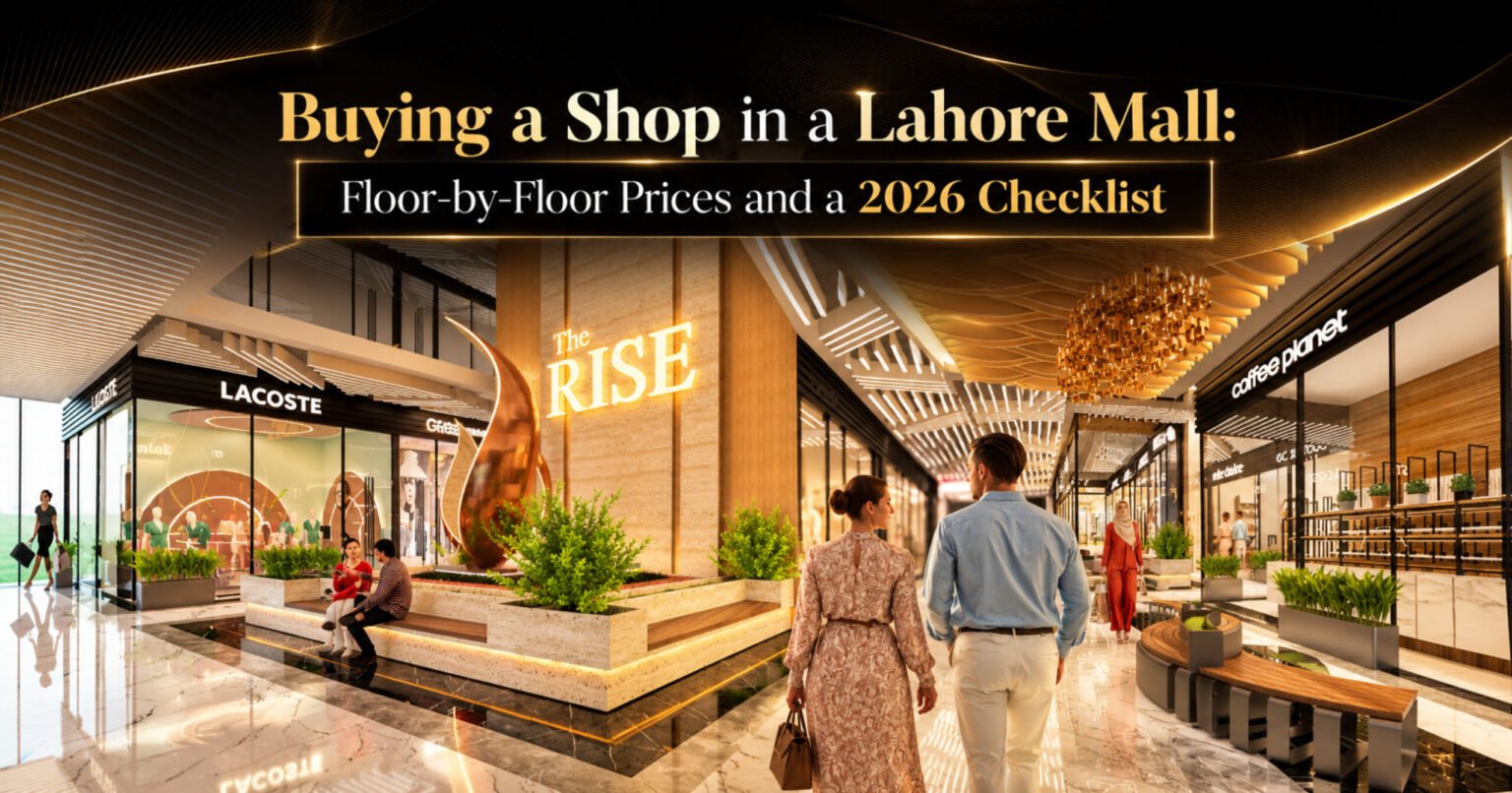
A shop earns from the people who walk past it. In a multi-storey mall, that footfall is not spread evenly: almost everyone who enters the building crosses the ground floor, fewer reach the first, fewer still the second, and the lower ground depends on how well it is connected to the entrances and the parking.
Developers price that difference in directly. Rather than one rate for the whole building, each floor gets its own rate per square foot, and within a floor the shops facing the main entrance or an atrium are priced above those tucked into a corner. When you compare “shop prices” between two projects without knowing the floor, you are comparing nothing at all.
A published floor-by-floor price list
Rather than generalise, here is a complete published price list. The figures below are from the August 2026 payment plan of The Rise Mall & Residencia on Main Raiwind Road, Lahore — a mixed-use building with commercial shops on the lower ground, ground, first and second floors and apartments above them.
| Floor | Rate (Rs/sq ft) | Shop sizes (sq ft) | Price range (Rs) |
|---|---|---|---|
| Ground floor | 51,000 – 67,000 | 153 – 1,013 | 8,058,000 – 67,871,000 |
| First floor | 31,000 – 34,000 | 153 – 423 | 4,743,000 – 14,382,000 |
| Second floor | 29,000 – 31,000 | 144 – 401 | 4,176,000 – 12,431,000 |
| Lower ground | 27,000 | 177 – 359 | 4,779,000 – 9,693,000 |
| Apartments above (for comparison) | 18,000 | 305 – 900 | 5,490,000 – 16,200,000 |
What this table tells you
The best ground-floor rate is about 2.5 times the lower-ground rate and nearly 3.7 times the residential rate in the same building. That gap is the price of footfall. It also means the entry ticket varies enormously: the cheapest shop in this building is a 144 sq ft second-floor unit at Rs 4,176,000, while a 1,013 sq ft ground-floor unit is Rs 67,871,000.
The same pattern shows up across Lahore
This is not one developer’s pricing quirk. A rate card published in June 2026 for a mall on Main Boulevard, Gulberg listed its ground floor at Rs 90,000 per square foot against Rs 50,000 on the first floor and Rs 40,000 on the second — a ground-floor premium of 2.25 times. In a project on the Raiwind Road corridor, ground-floor shops are advertised around Rs 30,000 per square foot while other floors in the same building sit near Rs 16,000.
What changes enormously between projects is the base rate itself. Across Lahore, shops listed for sale run from about Rs 6 lakh to Rs 55 crore, and the per-square-foot spread inside a single area can be tenfold:
| Area | Asking rates (Rs/sq ft) | What sits at each end |
|---|---|---|
| Gulberg | 19,000 – 200,000 | Older trade centres at the bottom; new MM Alam Road and CBD towers at the top |
| Bahria Town | 13,000 – 85,000 | Interior blocks against main-road and food-court frontage |
| Raiwind Road / Al-Kabir Town | 12,000 – 55,000 | Upper floors and basements against ground-floor units in completed commercial hubs |
Asking prices listed on Zameen.com, read on 30 September 2026; per-square-foot rates calculated from each listing’s own price and area. These are what sellers ask, not what buyers pay.
What moves the rate within one floor
Notice that the ground floor above is not a single number but a band from Rs 51,000 to Rs 67,000 per square foot. Inside one floor, these are the things that decide where a shop sits in that band:
- Frontage. How much of the shop’s width faces the walkway. A wide, shallow shop displays more and is worth more per foot than a narrow, deep one of the same area.
- Distance from the entrance. Units beside the main entrance or a road-facing door catch everyone who comes in.
- Escalators, lifts and atrium. Shops in sight of the vertical circulation get the traffic moving between floors.
- Corner position. Two open sides mean two display faces.
- Size. Very small units often carry a higher rate per square foot because demand for low-ticket shops is wide.
- Anchor neighbours. Proximity to a supermarket, food court or cinema that pulls people to that part of the floor.
Ask for the floor layout, not just the price list, and find your unit on it before you decide. The layout answers all six questions at once.
Worked example: what a small shop costs on installments
Commercial units in an under-construction building are usually sold on the same kind of payment plan as apartments. Taking the smallest unit in the published list — a 144 sq ft second-floor shop at Rs 29,000 per square foot, total Rs 4,176,000 on a 30-month plan:
| Payment | Share | Number | Amount each (Rs) | Total (Rs) |
|---|---|---|---|---|
| Booking | 10% | 1 | 417,600 | 417,600 |
| Confirmation | 15% | 1 | 626,400 | 626,400 |
| Monthly installments | 21.6% | 30 | 30,067 | 902,010 |
| Digging (milestone) | 10% | 1 | 417,600 | 417,600 |
| Grey structure (milestone) | 10% | 1 | 417,600 | 417,600 |
| Half-yearly installments | 18.4% | 5 | 153,677 | 768,385 |
| Possession | 15% | 1 | 626,400 | 626,400 |
| Total | 100% | 4,176,000 |
Installment amounts are as published and are rounded to the nearest rupee, so the individual lines add to a few rupees less than the stated total.
As with apartments, the monthly installment is the small part: thirty payments of Rs 30,067 cover 21.6% of the price, and 25% is due as booking and confirmation before those installments start. The same structure applied to a Rs 40 million ground-floor unit means a first-year cash requirement in the millions, so work out the schedule in rupees per month before choosing a floor.
Working out the return before you buy
A shop is bought for rent, resale, or to trade from yourself. For the first two, the arithmetic is the same as for any other property — and the inputs must come from the market, not from a sales pitch.
- Find real rents. Look up what comparable shops on the same floor of comparable buildings actually rent for, on Zameen or Graana. Take the middle of several, not the best one.
- Subtract the common-area maintenance (CAM) charge. In a managed mall this is a monthly per-square-foot charge for security, cleaning, cooling, lifts and marketing. It is a permanent cost of owning a shop — ask for the rate in writing before booking.
- Allow for empty months. Retail tenants change more often than residential ones, and a shop in a mall that has not yet built its footfall can sit empty for a long time after handover.
- Allow for fit-out. Shops are handed over bare. Flooring, shopfront, lighting and signage are yours or your tenant’s cost.
- Add the purchase taxes before you divide — the yield is on what you actually spent.
What to make of advertised yields
Scroll the shop listings for Lahore and you will see promises: “12% rental yield”, “rent from day one”, a specific monthly figure attached to a shop that does not yet exist. It is worth knowing what sits behind those numbers, which is this: no independent series publishes commercial rental yields for Lahore at all. The one methodologically sourced yield series that covers Pakistani cities, the Global Property Guide, covers residential property only, and put Lahore’s average gross apartment yield at 5.74% in its March 2026 update — the lowest of Pakistan’s four major cities.
Retail can certainly earn more than residential. But a double-digit figure printed in an advertisement has nothing independent behind it, and it is usually calculated on a rent nobody is paying yet.
Treat “guaranteed rent” offers with care
Some projects sell shops with a promised monthly return for the first few years. That promise is only as good as the company behind it, and it is often already priced into a higher purchase rate. Ask who pays it, from what income, what happens if the shop is empty, and what your remedy is if payments stop — and get the answers in the agreement, not in a brochure.
Note also who is not watching. In February 2025 the Securities and Exchange Commission of Pakistan warned the public about fraudulent real-estate investment schemes, making the point that registering a company with the SECP does not entitle it to raise deposits from the public, and that the SECP does not regulate real-estate investment schemes at all, other than Real Estate Investment Trusts. An SECP certificate or an FBR number shown to you as reassurance is not regulatory approval of an investment.
Approvals and documents to verify
A commercial unit carries an extra layer of approval compared with a plot or a house: the land must be authorised for commercial use, and the building itself must have an approved plan.
- Is the scheme approved? Start with the development authority’s own register of approved schemes — our verified list of LDA-approved societies in Lahore is built from it, with the approval status of each scheme.
- Is the plot commercial? Ask for the commercialisation documents for the specific plot, not a general claim about the area.
- Is the building plan approved, for the number of floors being sold? A shop on a floor that is not in the approved plan is a serious problem later.
- Who owns the land? Ask to see the title documents in the developer’s name.
- What exactly are you buying? The unit number, floor, covered area and whether the quoted area includes a share of common space.
- Completion and possession. The date, the delay clause, and what compensation applies if it slips.
- Maintenance structure. Who manages the mall after handover, how the CAM charge is set and how it can rise.
- Resale and transfer terms, including the transfer fee and whether transfer is allowed before possession.
Verify approvals with the authority directly rather than taking a copy at face value. The Lahore Development Authority publishes three pages that between them answer most of the question:
| Check | Where | What it tells you |
|---|---|---|
| Is the scheme approved? | LDA approved schemes | Around 400 schemes with location, approved area, number of residential and commercial plots, the approval stage and the date of approval |
| Is it on the blacklist? | LDA illegal schemes | Schemes LDA has declared illegal — the more important of the two lists to check |
| Is an application still pending? | LDA one-window status | The progress of a submitted application |
Read the approval stage carefully: on LDA’s own register a scheme can be listed as “Technically Approved” rather than “Final”, and those are not the same thing. Our verified list of LDA-approved societies reproduces that register with each scheme’s stage and date.
The completion certificate is not optional
Under LDA’s building regulations, a completion certificate is compulsory for a multi-storey building. The builder must give written notice within one month of finishing the work, and LDA inspects before issuing. The rules also set a building period — three years for plots up to two kanal, five years for larger ones — and overrunning it carries a daily fine that escalates the longer it continues. Two further points matter to a buyer:
- A certificate is issued only if the work matches the sanctioned plan. Deviations have to be compoundable and settled in writing first.
- A certificate that was obtained on misreported information can be cancelled afterwards by the authority, after a show-cause notice. So a certificate in hand is strong evidence, not an absolute guarantee.
Risks specific to under-construction shops
Delivery risk
- Construction stops or slows
- Possession slips by years
- Check the developer’s completed projects, not launches
Footfall risk
- A mall that never fills has no walk-past trade
- Ask about anchor tenants and leasing plans
- Upper floors suffer first
Cost risk
- CAM charges rise after handover
- Fit-out is on you
- Empty months between tenants
The risk buyers rarely price in: unpaid commercialisation dues
LDA has been sealing commercial properties through 2026 — 155 in April and 203 in May alone, across Gulberg, Faisal Town, Allama Iqbal Town and several other areas. The single most common reason is not illegal construction but non-payment of commercialisation fees: in the April action, 110 of the 155 sealed properties were fee defaulters. Those dues attach to the property, so ask for written proof that commercialisation charges on your building are paid up to date — and keep asking after possession, because the liability does not disappear when the shop changes hands.
None of these argue against buying a shop. They argue for buying one on a floor and at a price where the numbers still work if the optimistic case does not arrive on schedule.
Taxes on a commercial purchase in 2026
The federal rules changed on 1 July 2026, and much of what is still published online refers to the old ones.
- Buying (Section 236K). A buyer on the FBR’s Active Taxpayers List pays a flat 1.25% of fair market value, whatever the property is worth. Buyers who are not on the list pay several times that, on rates that still rise with value.
- Selling (Section 236C). A flat 2.75% of the consideration for filers.
- The “late filer” category and Section 7E have both been abolished by the Finance Act 2026.
- Federal excise duty on commercial property allotments and transfers, introduced in 2024, has been withdrawn. If a seller’s cost sheet still adds 3–7% FED, it is out of date — ask them to justify it.
- Rent you earn is taxed at source. Where a shop is let, the tenant withholds tax on the rent. For an individual landlord the deduction is progressive and, above Rs 2,000,000 of annual rent, works out at Rs 155,000 plus 25% of the excess; a company landlord is deducted at 15% if on the Active Taxpayers List. It is adjustable against your return, but it affects cash flow from the first month.
- Stamp duty and registration are provincial, and published figures currently conflict — generate an e-stamp challan for your own transaction rather than relying on any article, including an official page that has not been updated.
If the ticket size on the ground floor is beyond your budget, compare it with the residential side of the same building: our guide to the studio apartment price in Lahore works through a unit at Rs 18,000 per square foot, and the payment plan guide explains the installment structure in full.
Frequently asked questions
How much does a shop cost in a Lahore mall?
Why are ground-floor shops so much more expensive?
Can you buy a shop on installments in Lahore?
Is a shop a better investment than an apartment?
Are advertised “12% rental yield” claims on shops reliable?
What tax do I pay when buying a shop in Lahore in 2026?
What approvals should a mall shop have?
What are CAM charges?
See the shop layouts and the floor-wise plan
Commercial shops on four floors of a mixed-use building on Main Raiwind Road, Lahore, with apartments above.
Sources: The Rise Mall & Residencia published payment plan, August 2026 edition (lower ground, ground, first and second floor shop schedules; apartment schedule at Rs 18,000 per sq ft); per-square-foot rates calculated from the published total price and area of each unit. Comparative asking prices from Zameen.com retail shop listings for Lahore and its area pages, read 30 September 2026, plus a mall rate card published in June 2026. Rental yields: Global Property Guide, March 2026 update (residential). Regulator warning on real-estate investment schemes: Dawn, 8 February 2025, reporting the Securities and Exchange Commission of Pakistan. LDA enforcement figures: press reports of LDA sealing operations, April and May 2026. Approvals and completion certificate: Lahore Development Authority and its building and zoning regulations (2019, as amended). Tax rates: Finance Act 2026, in force 1 July 2026.
Listing figures are asking prices set by advertisers, not recorded sale prices. Prices, plans, fees and tax rates change over time — confirm current figures before booking. This article is general information, not financial, legal or tax advice.