
What Is a Mixed-Use Development? A Lahore Buyer’s Guide (2026)
“Mixed-use” has become one of the most used words in Lahore property marketing, and one of the least explained. This guide sets out what the term actually means, how the Lahore Development Authority’s rules treat a building with shops below and apartments above, what living or investing in one really involves — including the parts brochures leave out — and a checklist to use before you buy.
- What a mixed-use development actually is
- Vertical and horizontal mixed-use
- How LDA’s rules treat mixed-use buildings
- Mixed-use examples in Lahore and Pakistan
- What it offers residents and investors
- The trade-offs nobody puts in the brochure
- A worked example: how Rise is put together
- 10 things to check before you buy
- Frequently asked questions
What a mixed-use development actually is
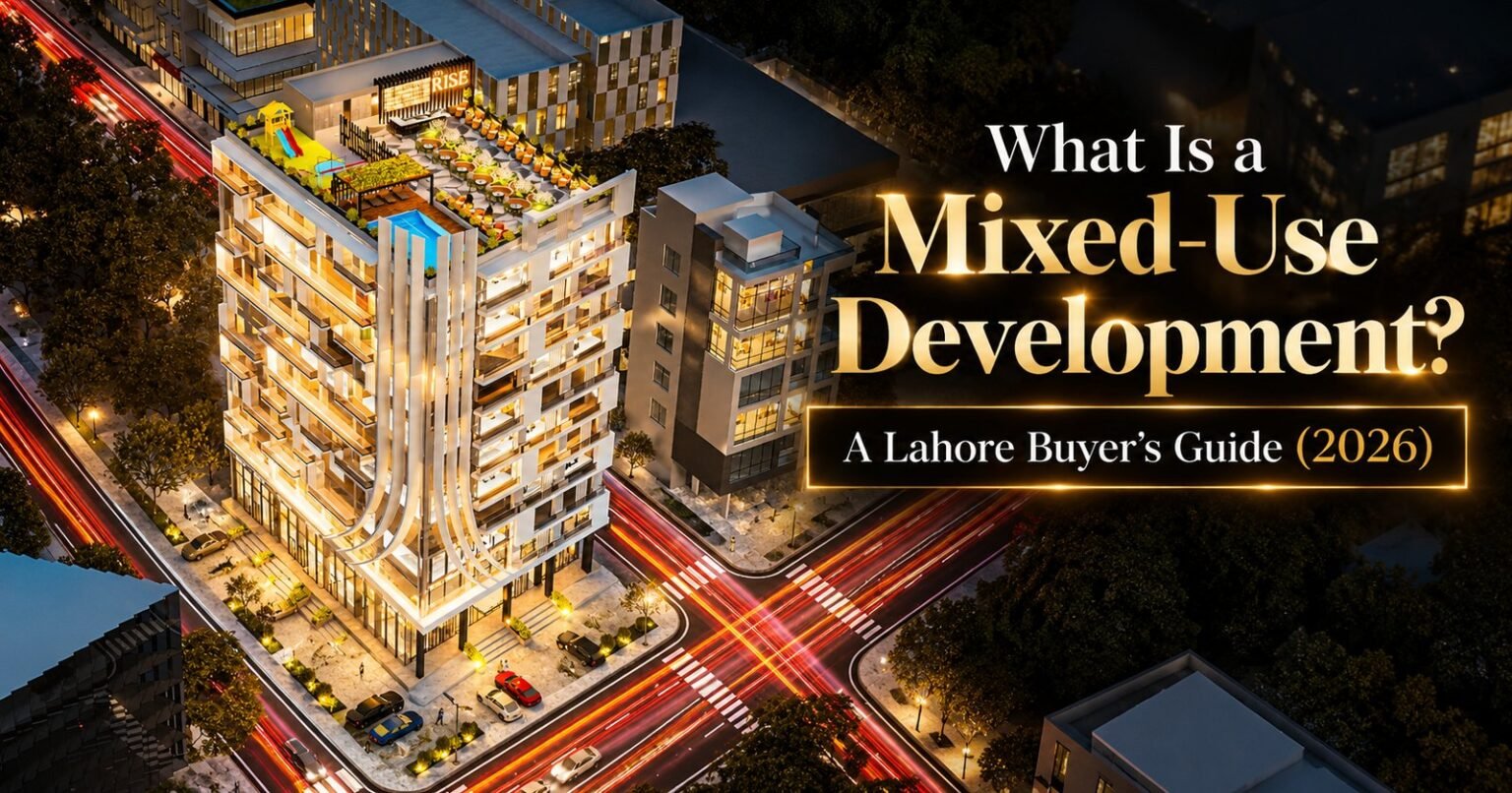
At its simplest, a mixed-use development puts more than one kind of use — homes, shops, offices, restaurants, a hotel, leisure — into a single planned project, so that people can live, work, shop and spend their free time in the same place.
The definition most often cited internationally comes from the Urban Land Institute (ULI), which sets three tests. A true mixed-use project has:
- Three or more significant revenue-producing uses — such as retail, office, residential, hotel or leisure — that support one another.
- Real physical and functional integration of those parts, including uninterrupted pedestrian connections between them.
- Development to one coherent plan, rather than unrelated buildings that happen to stand side by side.
A joint definition agreed in 2006 by the main US real estate industry bodies (ICSC, NAIOP, BOMA and the National Multi Housing Council) puts it more plainly: a project with “planned integration of some combination of retail, office, residential, hotel, recreation or other functions” that is “pedestrian-oriented and contains elements of a live-work-play environment.”
Mixed-use is not the same as “multi-use”
ULI separates genuine mixed-use from “multi-use” projects, which contain several uses but lack the integration and walkability that make them work together. A mall with a cinema and a food court is a multi-use retail centre; a mall with homes above it, where residents walk down to the shops, is mixed-use. The distinction matters because the benefits buyers are promised come from the integration, not from the list of uses.
Vertical and horizontal mixed-use
Mixed-use projects come in two broad shapes, and they suit different buyers.
| Type | What it looks like | Typical Lahore form | Who it suits |
|---|---|---|---|
| Vertical | Different uses stacked in one building — usually shops on the lower floors and apartments or offices above | A mall or commercial podium with residential floors on top, on a commercial plot | Buyers who want a compact, lock-up-and-leave home with daily needs downstairs |
| Horizontal | Separate single-use buildings — houses, apartment blocks, a commercial strip — planned together on one site | A large scheme or township with its own commercial area, apartments and villas | Families who want a house or a larger plot within a planned community |
Most of what is sold as “mixed-use” in Lahore today is vertical: a building on a commercial plot along a main road, with retail at the bottom and apartments above. That is the form this guide focuses on.
How LDA’s rules treat mixed-use buildings
For anyone buying in Lahore, the rules that matter are the Lahore Development Authority’s. Three points are worth knowing.
Mixed use is a land-use class in its own right
The LDA Land Use Regulations 2020 divide land into ten classes, and “mixed use” is one of them, alongside residential, commercial, industrial and others. In a mixed-use area the regulations permit “commercial on ground floor and offices-cum-residential area on upper floor.” In commercial areas, the permitted uses expressly include residential apartments, mixed-use buildings and shopping malls.
A commercial building may contain apartments
The LDA Building and Zoning Regulations 2019 define a commercial building as one with shops, offices, restaurants or similar uses “on any floor” that “may also have apartments in it.” In other words, apartments above shops on a properly commercial plot are an intended use, not a loophole. What a buyer still has to confirm is that the specific plot is commercial (or has been converted, with the conversion fee paid) and that the specific building plan has been approved.
Plot size decides how tall a building can go
For commercial plots, the 2019 regulations set height by plot size and road width. As compiled in January 2020, the table reads:
| Category | Plot size | Storeys | Max height | Min. road width |
|---|---|---|---|---|
| Low rise | Under 1 kanal | G+3 | 50 ft | 30 ft |
| Medium rise 1 | 1 to under 2 kanal | G+6 | 90 ft | 30 ft |
| Medium rise 2 | 2 to under 4 kanal | G+9 | 120 ft | 40 ft |
| High rise 1 | 4 to under 6 kanal | G+14 + service floor | 200 ft | 60 ft |
| High rise 2 | 6 to under 12 kanal | G+23 + service floor | 300 ft | 80 ft |
| Skyscraper | 12 kanal and above | No set limit (CAA clearance needed) | Above 300 ft | 80 ft |
Maximum ground coverage is 65% in every category except skyscrapers (50%). In August 2025 the LDA Governing Body approved amendments to these regulations, including changes to the floor area ratio for high-rise buildings and making basements optional; the revised figures had not been published in a consolidated form at the time of writing, so ask for the rules applied to the building you are considering.
Two further rules are directly relevant to buyers. First, parking is calculated separately for each use in a building used for several purposes — one car space per 1,600 sq ft for apartments and for shops, and one per 500 sq ft for restaurants and cafes — and may be provided within 200 metres of the plot. Second, buildings on plots of four kanal or more need two emergency staircases at the two ends of each floor, in addition to the main stairs.
Check who the regulator is
LDA’s land-use rules cover the Lahore Division except the cantonments, DHA and the Ravi Urban Development Authority’s area. A mixed-use building in DHA, for example, is approved under DHA’s own bylaws. Before relying on any rule in this guide, confirm which authority approved the building you are looking at.
Mixed-use examples in Lahore and Pakistan
Looking at existing projects is the quickest way to see the difference between a true mixed-use building and a large mall.
- The Centaurus, Islamabad. Pakistan’s best-known vertical mixed-use project: a multi-storey mall opened in 2013, with tall towers containing residential and office space and a hotel. It shows the full live-work-shop-stay model in one complex.
- Grand Square Mall, Gulberg, Lahore. Retail on the lower floors with offices and studio, one- and two-bedroom apartments above — the classic Lahore vertical mix.
- Lahore Central Business District, Walton. A government-led district planned as a mixed-use commercial hub, with high-rise residential, offices and retail across a large site — horizontal and vertical mixing at district scale.
- Emporium Mall and Packages Mall. Both combine retail with cinemas, food courts and, in Emporium’s case, a hotel and banquet halls. Neither has homes inside, so by ULI’s tests they are large multi-use retail centres rather than residential mixed-use — a useful reminder that size alone does not make a project mixed-use.
What it offers residents and investors
For people who live there
- Daily needs within a lift ride. Groceries, pharmacy, food, a gym and a place to work without getting in the car — increasingly valuable as Lahore’s traffic worsens.
- Security and services at building scale. Controlled entry, guards, backup power and maintenance are easier to provide, and to pay for, in a building with commercial income alongside the homes.
- Amenities a standalone block cannot support. Pools, cinemas, rooftop restaurants and co-working spaces need footfall beyond the residents; the commercial floors supply it.
For investors
- A built-in tenant pool. People who work in or near the commercial floors, and professionals who want a compact home on a main road, are natural renters for studios and one-bedroom units.
- Smaller units tend to yield more. The Global Property Guide’s March 2026 update puts Lahore’s average gross apartment yield at 5.74%, with studios at 5.53%, one-bedroom units at 6.71% and two-bedroom units at 7.74%. Net yields are typically 1.5–2 percentage points lower once costs are deducted.
- Rental demand is moving outward. Reporting in July 2026 described rising rents in central Lahore pushing families toward areas including Raiwind Road, LDA Avenue and Bahria Orchard.
What about a “mixed-use premium”?
In the United States, JLL research published in March 2022 found that apartments in mixed-use settings achieved a 31% rental premium and 2.9% higher occupancy than their local averages. No equivalent study exists for Lahore. Treat any claim that a mixed-use apartment here will rent or sell for more as unproven, and judge each building on its location, management and the rents comparable units actually achieve.
The trade-offs nobody puts in the brochure
Mixed-use buildings are more complicated to run than a plain apartment block. None of these is a reason to avoid one, but each is a reason to ask questions.
Noise, smells and footfall
- Restaurants, events and late shopping hours are part of the package
- Ask where kitchen exhausts, loading bays and generators are
- Higher floors and units away from the food court are quieter
Shared costs
- Service charges must be split between shops and homes — notoriously hard to get right
- Commercial owners will push to keep their share low
- Ask how the split is calculated, in writing
Access and privacy
- The best buildings give residents their own entrance and lifts
- Shared lifts mean shoppers in your lobby
- Check how visitor and resident parking are separated
Ownership of common areas
- Punjab has no apartment ownership (condominium) law yet
- Your rights rest on the sale agreement and the building’s bylaws
- Read who owns and manages the lobby, roof and parking
Fire safety deserves its own mention. After the Gul Plaza fire in Karachi in January 2026, the Punjab government ordered fire-safety audits of markets, commercial buildings and high-rises. Under the Punjab Community Safety Act 2021 and the Building Regulations made under it in 2022, tall buildings need a Safety Measure Certificate from Rescue 1122, renewed every year. For a mixed-use building, where crowds of shoppers share a structure with families sleeping upstairs, ask to see it — and look for the emergency staircases, fire doors and alarms the rules require.
Good management is the whole game
The same features that make a mixed-use building convenient — shops, restaurants, visitors, shared services — make it degrade quickly if it is badly run. Before buying, ask who will manage the building after handover, how the maintenance fund is collected and audited, and how residents are represented. A well-managed mixed-use building ages well; a neglected one ages fast.
A worked example: how Rise is put together
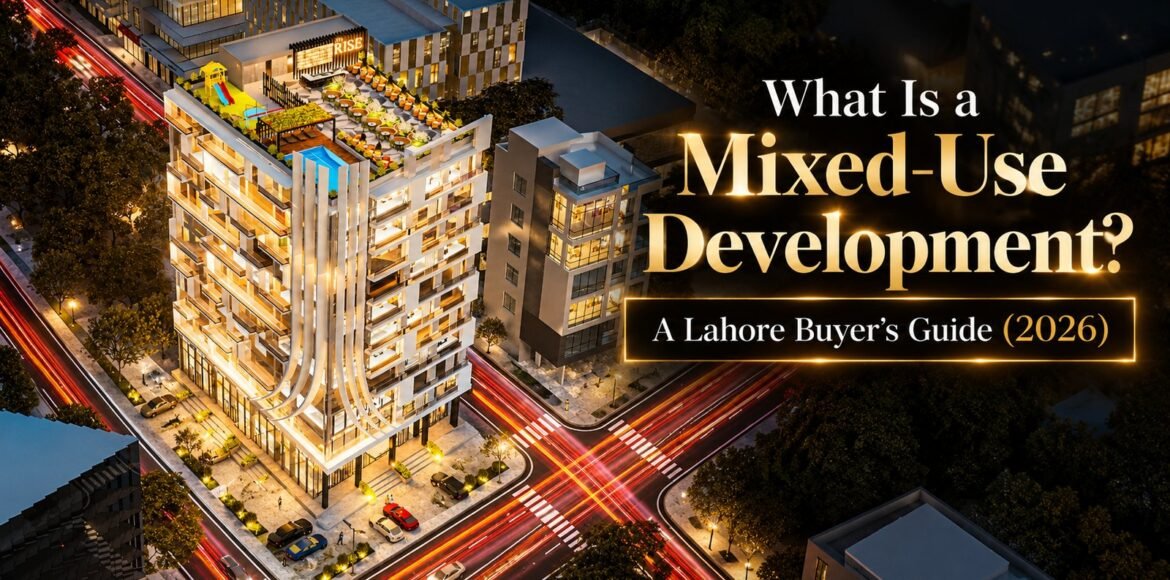
To make this concrete, here is how one Lahore vertical mixed-use project is arranged. The Rise Mall & Residencia stands on a 4.5-kanal commercial plot at Jinnah Avenue Commercial, Al-Kabir Town Phase 2, on Main Raiwind Road opposite Lake City. The figures below are from its project brochure.
- Retail podium. Shops occupy the lower ground, ground, first and second floors, with apartments on the floors above.
- Homes in three sizes. Studios of 305 and 360 sq ft, one-bedroom apartments of 500 sq ft and two-bedroom apartments of 820 and 900 sq ft.
- Shared amenities. A rooftop restaurant, pool, gym, spa, cinema, day care, co-working space and prayer room, with valet parking, smart entry and round-the-clock security.
- Location. Around two minutes from Adda Plot and three from the Ring Road, on one of Lahore’s main southern corridors.
Use the checklist below on Rise exactly as you would on any other project. For the payment side, Rise’s current prices and schedule are in our Rise Mall payment plan guide, our guide to reading an apartment payment plan explains how plans like it work, and the guide to buying a shop in a Lahore mall covers the retail floors.
10 things to check before you buy
- The land use. Confirm that the plot is commercial or mixed-use under the approving authority’s rules, or that its conversion has been approved and the fee paid.
- The scheme’s approval. Check the society or scheme on the authority’s register — our list of LDA-approved societies in Lahore is built from LDA’s own records.
- The building plan approval, covering the floors you are buying on, not just the podium.
- Fire safety. Emergency staircases, fire doors, alarms and hydrants, and the Rescue 1122 certificate once the building is occupied.
- Separate residential access. Ask whether residents have their own entrance, lobby and lifts.
- Parking. How many spaces are allocated to apartments, and whether yours is reserved or shared with shoppers.
- The service-charge split between commercial and residential owners, and what the residential charge covers.
- Ownership and management. Who owns the common areas, who runs the building after handover, and how owners are represented.
- Where the noise comes from. Locate the food court, restaurant kitchens, generators and loading area relative to your unit.
- The developer’s record on completed, delivered and well-run buildings — mixed-use management is harder than building.
Still deciding what to buy? See what a studio apartment costs in Lahore, or weigh an apartment against land in our flat vs plot comparison. For the wider corridor, our Raiwind Road societies guide covers approved schemes and connectivity.
Frequently asked questions
What is a mixed-use development in simple words?
What is the difference between vertical and horizontal mixed-use?
Are apartments allowed above shops in Lahore?
Is an apartment in a mixed-use building a good investment in Lahore?
What are the disadvantages of living in a mixed-use building?
Who owns the common areas in a Lahore apartment building?
Does a mixed-use building need a fire safety certificate in Punjab?
See a mixed-use building up close
Shops, studios, one- and two-bedroom apartments and 35+ amenities on Main Raiwind Road, Lahore — walk through it with our team.
Sources: Urban Land Institute definition and the 2006 ICSC/NAIOP/BOMA/NMHC definition as set out in ICSC, “Mixed-Use or Mixed Blessing” (November 2021). LDA Building and Zoning Regulations 2019, consolidated with amendments to 28 January 2020 (clauses 1.1, 3.1.1, 3.11, 5.4.4 and 5.5.1); amendments approved by the LDA Governing Body, reported August 2025. LDA Land Use Regulations 2020 (clauses 2, 4, 7 and 27); both via LDA downloads. Fire safety: Rescue 1122 building safety (Punjab Community Safety Act 2021 and Buildings Regulations 2022); Punjab fire-audit order reported January 2026. Condominium law: Dawn, 24 March 2025. Rental yields: Global Property Guide, March 2026 update. Rent trends: Profit (Pakistan Today), 14 July 2026. US mixed-use premium: JLL Research, March 2022. Project facts: The Rise Mall & Residencia project brochure.
Regulations are amended from time to time and other authorities apply outside LDA’s area — confirm the rules for your building before deciding. This article is general information, not legal, financial or investment advice.